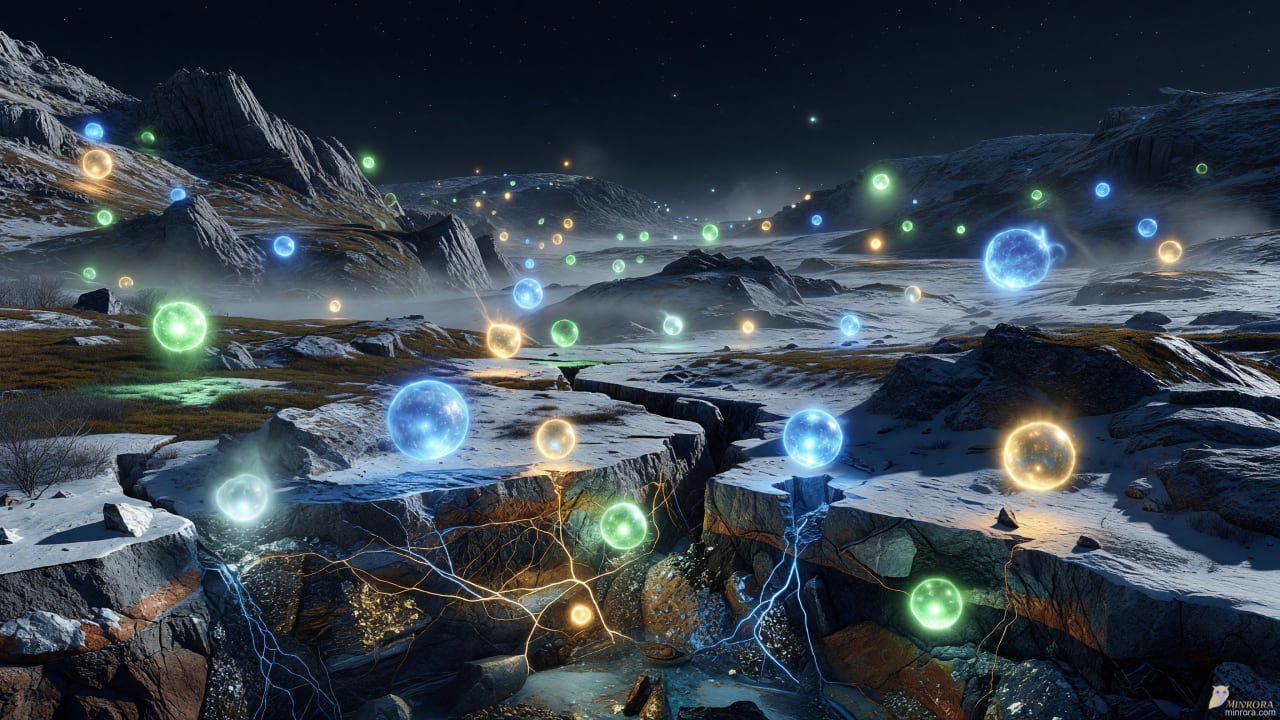
The Hessdalen Lights: Natural Geological Batteries
In the winter of 1981, the Hessdalen valley in Norway began to act as if someone had left a door open in the sky. Not as a poetic image: white, yellow, and red lights appeared above the mountains, stopped silently, crossed the valley at high speed, and sometimes seemed to split into several glowing spheres. For a community of only a few hundred people, this was not a pub rumor. It was something people could see from the kitchen window.
The scene had every ingredient of an impossible file. Snow, Nordic darkness, isolated farms, sober witnesses, and a light that did not ask permission. Between December 1981 and 1984 there were so many sightings that the story stopped being local folklore and entered the scientific agenda. Engineer Erling Strand, from Østfold University College, organized what became known as Project Hessdalen in 1984. For several weeks, a team placed cameras, radars, magnetometers, and spectrum analyzers in the valley. They did not arrive with incense or tin foil hats. They arrived with instruments.
And the instruments recorded something. In January and February of 1984, the team documented dozens of luminous events. Some lights were visible for seconds; others for minutes. Some seemed to drift slowly, like a lantern pulled by an invisible string. Others accelerated in ways that looked deeply puzzling. In certain cases, radar echoes appeared to be associated with the lights. For UFO believers, this was pure fuel: if a camera sees it and radar confirms it, then it must be a craft. Case closed. Dramatic music. Cut to black.
But good mysteries are not solved with a convenient sentence. In the following years, researchers such as Bjørn Gitle Hauge and Italian astrophysicist Massimo Teodorani returned to Hessdalen with better equipment. They found that the phenomenon was not one single thing. Some lights were aircraft, planets, reflections, or distant headlights distorted by cold air. But others remained genuinely strange: luminous emissions in a region with unusual geology, conductive minerals, moisture, snow, and a valley that behaves like a natural trap for electric charge.
- The lights exist: they are not just mountain stories.
- They do not prove extraterrestrial visitors.
- The most promising explanation sounds less like science fiction and more like cosmic hardware: a giant battery made of rock, water, and ionized air.
And that is where the myth becomes uncomfortable: maybe the craft was never above us, but beneath our feet.