OOPArts: The London Hammer and the Pieces 'Out of Time'
Archivos Clasificados: Desmitificando lo Imposible · Chapter 7
OOPArts: The London Hammer and the Pieces 'Out of Time'
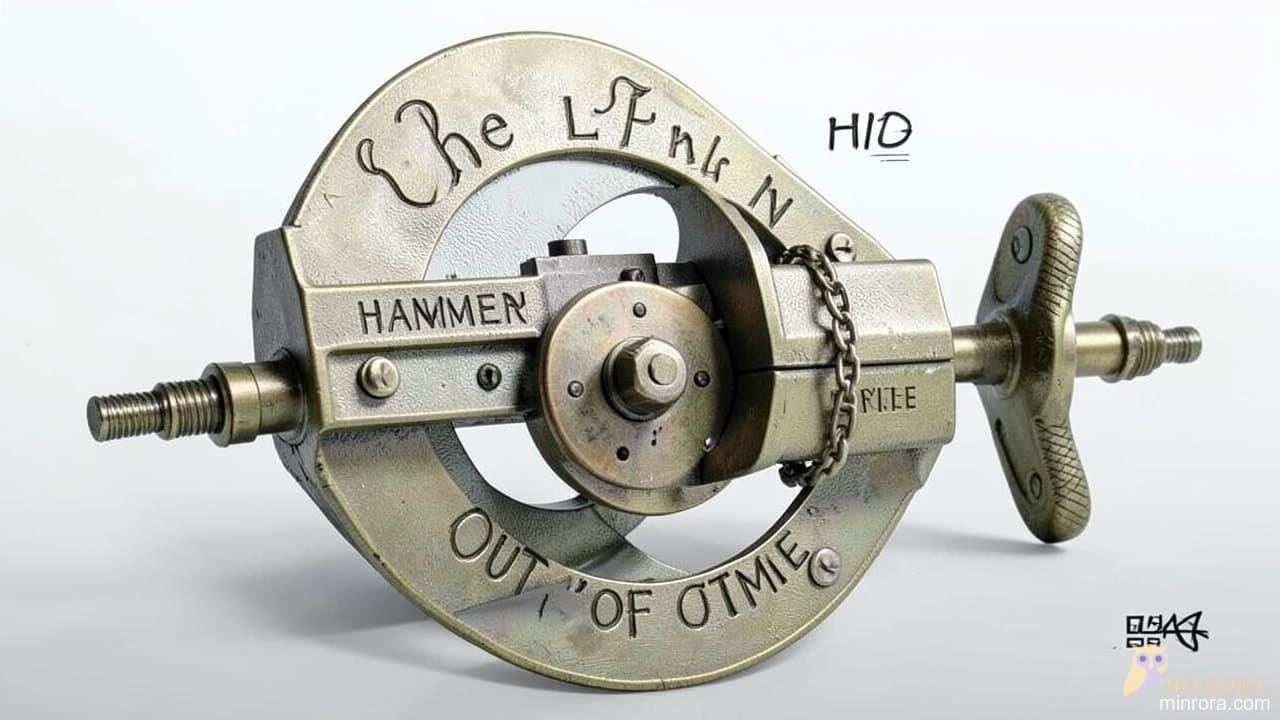
Picture the scene: Texas, 1936. Near the small town of London, Max Hahn and his wife Emma are walking along Red Creek after a storm. Among loose stones they find a strange rock, a kind of stone egg with a piece of wood sticking out. It does not look like much. They take it home. Years later, according to the family story, someone breaks the rock with a blow. And there it is: an iron hammer trapped inside.
Now let the myth breathe for a second.
A hammer inside a rock. A human tool, with a wooden handle, sealed in stone as if it had been frozen there for millions of years. If that rock were truly ancient, the object would be a bomb thrown into official history: humans making metal tools before dinosaurs, before modern mammals, before almost everything we think we know. It would not be a hammer. It would be a grenade tossed into the archive of science.
The object became famous as the 'London Hammer', not because of the British capital, but because of London, Texas. In later decades it was promoted by preacher and collector Carl Baugh, associated with the Creation Evidence Museum in Glen Rose. In books, lectures and websites, the hammer appeared as an OOPArt: an 'Out Of Place Artifact'. The label is perfect fuel for imagination. It sounds like a classified file, a forbidden object, proof someone does not want you to examine too closely.
And it is not alone. The OOPArt display case has other famous suspects:
The 'Coso artifact', found in 1961 in California: it looked like a technological component trapped inside an ancient geode. It later turned out to be a Champion spark plug from the 1920s.
The Antikythera mechanism, recovered from a Greek shipwreck in 1901: a real, ancient and extraordinary astronomical computer, but not an impossible one.
The so-called 'Baghdad battery', jars found in Iraq that some imagined as ancient electric cells, though their actual function remains debated.
The pattern is irresistible: a modern object, or one that seems too sophisticated, appears where it 'should not'. Our brains love those cracks. It is like finding a cell phone inside an Egyptian tomb: in one second, the mind jumps from 'that is odd' to 'they hid the truth from us'.
But the London Hammer hides a trick more elegant than a conspiracy: nature can build a stone prison around a recent object. And once we understand how it does that, the mystery does not vanish. It becomes more interesting.
🎁 Free access for a limited time
How would you like to continue?
Soon will require watching a short ad